
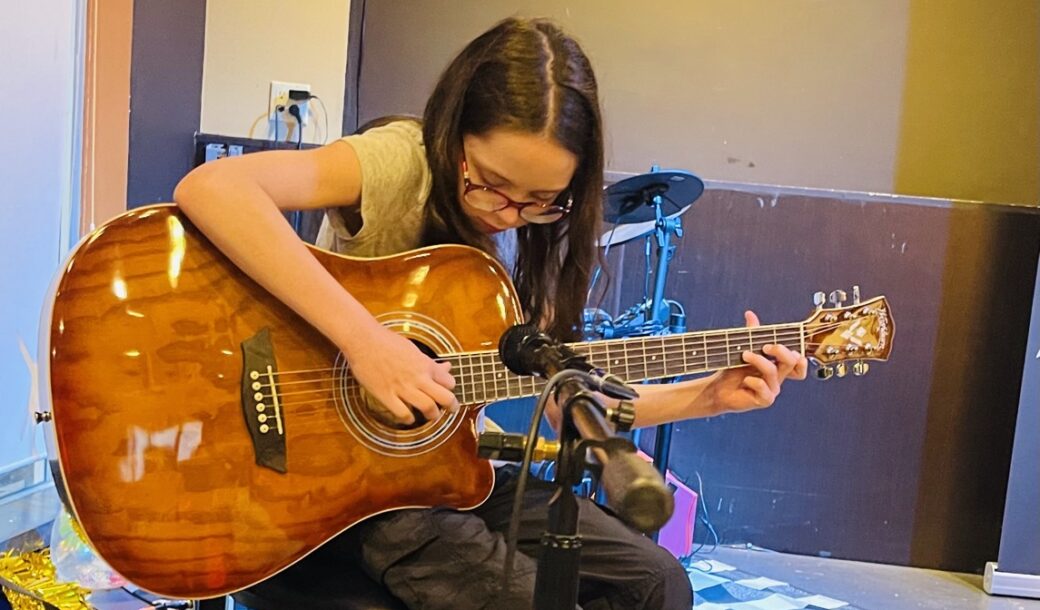
Discover the benefits of guitar lessons
Plugging into guitar lessons is a fantastic idea for the young people in your life, from the little tykes to the eye-rolling teenagers. Forget the old-school image of dusty sheet music and stern teachers; modern guitar lessons are an absolute blast, and they offer a whole symphony of benefits that stretch far beyond just making music.
At U-Rock, we’ve taught guitar lessons to hundreds of kids and teens in Stittsville and Kanata, so we’ve learned a thing or two about making kids shine. Learn more about guitar lessons at U-Rock.
Strumming Up Smarts: Brain Power for the Win!
Let’s start with what’s going on inside their heads. Picture this: your child’s fingers are trying to find the right fret, their eyes are scanning a chord chart or tab, their ears are listening for the right sound, and their brain is simultaneously trying to keep a steady rhythm. That’s not just playing music; that’s a serious brain workout!
For younger kids especially, this multi-sensory engagement is pure gold. It massively boosts fine motor skills and hand-eye coordination. Think about it: they’re learning precise finger movements, building up dexterity, and making their hands do exactly what their brain tells them to. These are skills that transfer directly to everything from better handwriting to improved performance in sports. It’s like secretly training their brain and body while they’re having fun!
And it’s not just physical coordination. Playing guitar is a massive boost for memory. They’re memorizing chord shapes, string names, song structures, and even different strumming patterns. This constant memory recall strengthens those neural pathways, making it easier for them to remember things in school, whether it’s historical dates or math formulas.
Then there’s the concentration and focus aspect. In our super-distracted world, anything that encourages sustained attention is a gift. Learning a song or mastering a new technique demands focus. They have to block out distractions and really home in on the task at hand. This improved ability to concentrate carries over into homework, classroom learning, and just generally paying attention in a noisy world.
And don’t even get me started on problem-solving. Every time they encounter a tricky chord change, a fast riff, or a part of a song that just isn’t sounding right, they’re engaging their problem-solving skills. They learn to break down challenges into smaller pieces, experiment with different approaches, and celebrate when they finally figure it out. That’s real-world critical thinking, wrapped up in a musical package.
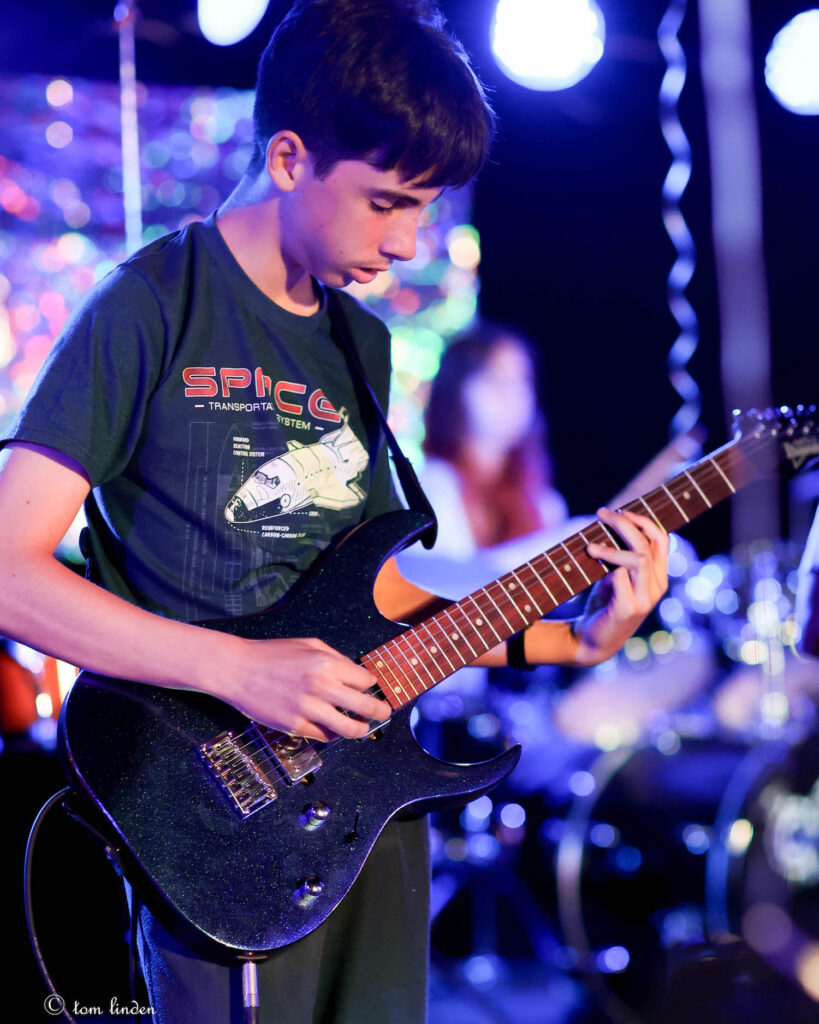
Beyond the Fretboard: Emotional & Mental Well-being
Now, let’s talk about the feelings. Those tricky tween and teen years? They can be a rollercoaster. And guess what? The guitar can be an incredible, healthy outlet for all those swirling emotions.
The guitar provides an amazing channel for self-expression. Sometimes, words just aren’t enough, or it’s hard to articulate what’s going on inside. Playing a soulful melody, a powerful rock riff, or a catchy pop tune allows them to vent, celebrate, or simply explore their feelings in a way that’s creative and non-verbal. It’s a fantastic stress reliever. After a tough day at school, or when they’re feeling anxious about something, picking up the guitar and just playing can be incredibly calming and therapeutic. It’s a mindful activity that helps quiet the noise in their head.
And let’s not overlook the absolute gold standard of benefits: confidence and self-esteem. Imagine a little kid’s face lighting up when they play their very first complete song. Or a teenager, who might feel awkward or unsure in other areas of their life, absolutely nailing a guitar solo they’ve been practicing. That sense of accomplishment is immeasurable. It shows them that with effort and practice, they can achieve amazing things. It builds a belief in themselves that spills over into every other aspect of their lives.
Learning guitar also teaches patience and discipline. Instant gratification is the name of the game for many kids these days. The guitar teaches them that true mastery takes time, persistence, and showing up even when you don’t feel like it. They learn the value of consistent practice and the joy of seeing gradual improvement. That kind of grit and perseverance is a life skill that’s hard to put a price on.
Plugging Into Connection: Social Benefits
Music, by its very nature, is a social activity. And the guitar is arguably one of the most social instruments out there.
Learning guitar opens doors to making new friends. Imagine being able to jam with buddies at school, form a garage band, or simply share a common interest with other music lovers. It’s a fantastic way to bond and build relationships. It can be a social icebreaker for shy kids, giving them a common ground to connect with others.
If they end up playing in a band or an ensemble, they’ll learn vital teamwork skills. They’ll discover how to listen to others, blend their sound, follow cues, and contribute to a collective goal. It’s like a real-world lesson in collaboration, where everyone’s part is important for the whole piece to sound good.
And for those who might be a little more introverted or struggle with traditional team sports, music offers a different kind of camaraderie. It’s a shared passion that can lead to deep, meaningful friendships based on creativity and mutual appreciation.
Plus, there’s the sheer cool factor. Being able to pull out a guitar at a bonfire, a family gathering, or a school talent show is, well, pretty awesome. It gives them a unique skill to share, boosts their social standing (let’s be real, that matters to teens!), and can be a wonderful way to entertain and connect with people.
Beyond the Basics: Creativity and Lifelong Joy
Finally, guitar lessons aren’t just about regurgitating songs note-for-note. They ignite creativity. As kids and teens learn the fundamentals, they start to experiment. They’ll try changing chords, improvising melodies, or even writing their own simple songs. This exploration of sound is incredibly empowering and can unlock a lifelong passion for composition and artistic expression.
And that’s the real kicker: the guitar can become a lifelong source of joy and fulfillment. It’s not a hobby they’ll outgrow. Whether they become a professional musician, play in a weekend band, or simply strum for their own pleasure, the skills and appreciation for music they develop now will stay with them forever. It’s a portable, personal passion that can provide comfort, excitement, and endless possibilities for decades to come.
So, if you’re weighing the pros and cons of guitar lessons for your child or teenager, know that you’re not just signing them up for a few half-hour sessions a week. You’re investing in their cognitive development, their emotional well-being, their social skills, and their potential for lifelong creative expression and happiness. Sounds like a pretty good deal, doesn’t it?
So, whether your kid is a little one just starting out or a teenager looking for a cool new hobby, guitar lessons are a solid choice. It’s not just about learning notes; it’s about growing, expressing, and just generally becoming a more well-rounded, awesome human being. And that’s pretty sweet, eh?
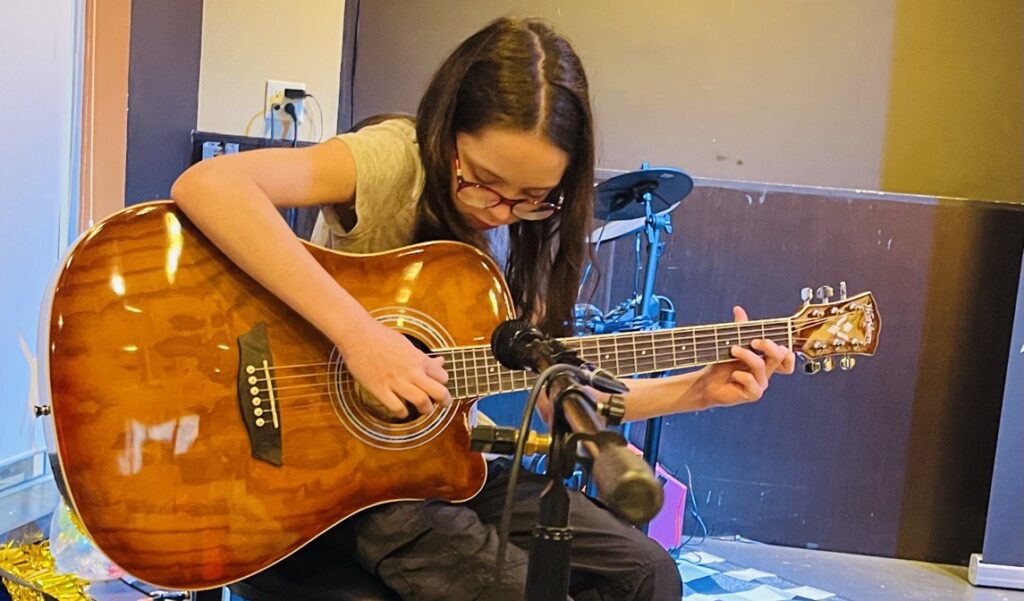
Beginner guitar lessons
Guitar lessons are more than just memorizing notes and scales; They’re about discovering a whole new way to express yourself creatively and having a great time doing it. Plus, with a good teacher, you’ll have someone cheering you on and making sure you’re building solid habits right from the start.
Guitar lessons for kids typically focus on building a strong foundation in a fun and engaging way, recognizing that children often have shorter attention spans and smaller hands. Here’s a breakdown of what kids usually learn:
I. Fundamental Guitar Skills:
- Holding the Guitar and Proper Posture: Learning how to sit comfortably, hold the guitar correctly (even with smaller, ¾ or ½ size guitars), and position their hands for optimal playing.
- Parts of the Guitar: Identifying and understanding the different components of the guitar (headstock, tuning pegs, neck, frets, strings, soundhole, etc.).
- String Names and Numbers: Memorizing the names of the open strings (E, A, D, G, B, E) often using mnemonic devices (e.g., “Every Apple Does Good By Eating”). They’ll also learn the string numbering (1st string is thinnest, 6th is thickest).
- Basic Strumming Techniques: Developing a consistent rhythm and learning simple strumming patterns. This often starts with open strings before moving to chords.
- Single Notes and Basic Riffs: Playing individual notes on specific frets, often starting with the low E string. This leads to learning simple, recognizable melodies or “riffs” (e.g., “Mary Had a Little Lamb,” “Hot Cross Buns,” “Smoke on the Water,” “Seven Nation Army”).
- Basic Chords: Introduction to simple, “open” chords that are easier for smaller hands to manage. Sometimes, teachers will even introduce one-finger simplified versions of chords before progressing to full shapes (e.g., simplified C and G chords). Common beginner chords include G, C, Em, Am, D.
- Finger Placement and Dexterity: Developing finger strength, coordination, and precision for fretting notes and forming chords. This can be challenging at first, and exercises are often incorporated to build these skills.
- Reading Guitar Tablature (TAB): This is a simplified way of reading music that is often preferred for beginners, as it visually represents where to place fingers on the fretboard.
- Tuning the Guitar: Understanding the importance of a tuned guitar and learning how to use an electronic tuner.
II. Musical Concepts (often introduced gradually and practically):
- Rhythm and Timing: Learning about beats, measures, and different note values (whole, half, quarter notes) through clapping, counting, and playing along to metronomes or backing tracks.
- Listening Skills: Developing an ear for different sounds, pitches, and rhythms.
- Basic Music Theory (Applied): While not always explicitly taught as “theory” at first, kids will learn practical elements like how pressing down on a string changes the note, or how chords create different sounds.
III. Beyond Technical Skills:
- Patience and Discipline: Guitar lessons require consistent practice and perseverance, teaching kids the value of these traits.
- Concentration: Focusing on finger placement, strumming, and listening all improve concentration.
- Problem-Solving: Figuring out how to play a new chord or navigate a difficult section of a song enhances problem-solving skills.
- Creativity and Self-Expression: As they progress, kids can experiment with different sounds, improvise, and even begin to write their own simple melodies.
- Confidence and Accomplishment: Mastering new skills and playing songs provides a significant boost to self-esteem.
- Hand-Eye Coordination and Fine Motor Skills: The intricate movements required for playing directly improve these physical abilities.
- Memory: Remembering chord shapes, song structures, and finger patterns enhances memory function.
- Enjoyment of Music: Most importantly, guitar lessons aim to foster a love and appreciation for music, making the learning process fun and rewarding.
Teachers often tailor lessons to a child’s age, interests, and learning style, incorporating songs they enjoy and making the experience as playful and encouraging as possible.
Intermediate guitar lessons
Intermediate guitar lessons build upon the foundational skills learned as a beginner, moving towards greater musicality, versatility, and understanding of the instrument. The focus shifts from simply playing notes and chords to understanding why they work together and how to use them expressively.
Here’s a breakdown of what intermediate guitar lessons typically cover:
I. Advanced Chord Knowledge and Application:
- Barre Chords (Bar Chords): Mastering the technique of using one finger to hold down multiple strings across a fret.This is a crucial step that unlocks playing in any key and significantly expands the chord vocabulary.
- Seventh Chords and Beyond: Learning major 7, minor 7, dominant 7, diminished 7, minor 7b5 (half-diminished), and augmented chords. Understanding their construction and how they function in different musical contexts.
- Chord Voicings: Exploring different ways to play the same chord (e.g., different inversions) across the fretboard, adding color and variety to rhythm playing.
- Slash Chords: Understanding chords where the bass note is different from the root of the chord (e.g., C/G). These create smoother transitions and richer harmonies.
- CAGED System: This system helps guitarists visualize and connect chord shapes and scale patterns across the entire fretboard, making it easier to play in different positions and keys.
II. Expanded Scale and Lead Guitar Concepts:
- Diatonic Scales: Mastering the major scale and its relative minor (natural minor) in multiple positions across the fretboard.
- Modes: Introduction to the modes of the major scale (Ionian, Dorian, Phrygian, Lydian, Mixolydian, Aeolian, Locrian). Understanding their unique sounds and applications for improvisation and composition.
- Pentatonic Scales (Advanced): While introduced as a beginner, intermediate lessons delve deeper into all five positions of both major and minor pentatonic scales, and how to connect them seamlessly for lead playing.
- Blues Scale: Learning the blues scale (pentatonic plus the “blue note”) and its application in blues and rock improvisation.
- Arpeggios: Playing the individual notes of a chord in sequence, which is essential for lead guitar, melodic solos, and improvising over chord changes.
- Lead Guitar Techniques:
- Bending and Vibrato: Developing expressive bending (intonation and control) and various vibrato techniques (finger, wrist).
- Hammer-ons and Pull-offs (Legato): Refining these techniques for smoother, faster playing and connecting notes.
- Slides: Using slides for smooth transitions between notes.
- Alternate Picking: Developing speed and precision with consistent up-and-down picking.
- Economy Picking/Sweep Picking (Introduction): Learning more efficient picking techniques for faster runs.
- Harmonics: Understanding natural and artificial harmonics for special effects.
- Tapping (Introduction): Using the picking hand fingers to fret notes on the fretboard.
- Whammy Bar Techniques (if applicable): For electric guitarists, exploring dive bombs, flutters, and other expressive techniques.
III. Music Theory (Deeper Dive):
- Intervals: Understanding the distance between notes and how they contribute to melody and harmony.
- Chord Construction: Deeper understanding of how chords are built (triads, seventh chords, extensions) from scales.
- Key Signatures: Understanding how key signatures relate to scales and chords.
- Chord Progressions: Analyzing common chord progressions in various genres and learning how to apply scales and arpeggios over them.
- Reading Standard Notation (Optional but Recommended): While tablature is popular, learning to read standard notation opens up a vast amount of musical literature and deepens theoretical understanding.
IV. Rhythmic Sophistication:
- Advanced Strumming Patterns: Incorporating syncopation, muting, and more complex rhythms.
- Fingerstyle/Travis Picking: Developing independent finger control for playing melodies and bass lines simultaneously (often for acoustic guitarists).
- Groove and Feel: Focusing on playing with better rhythm, timing, and musicality, often through playing along with backing tracks and metronomes.
V. Musicality and Application:
- Ear Training: Developing the ability to recognize intervals, chords, and melodies by ear. This is crucial for improvising, transcribing songs, and understanding music.
- Improvisation: Applying scales, modes, and arpeggios over backing tracks and chord progressions to create spontaneous melodies.
- Song Analysis and Learning: Breaking down and learning more complex songs from various genres, applying the new techniques and theory learned.
- Introduction to Different Genres/Styles: Exploring blues, jazz, funk, folk, rock, metal, etc., and learning the specific techniques and approaches associated with each.
- Creative Riff Writing/Songwriting (Beginner): Encouraging students to use their newfound knowledge to create their own musical ideas.
- Playing with Others: Developing the ability to play in time and interact musically with other musicians (if in a group setting).
Intermediate guitar lessons are about connecting the dots, building on the fundamentals, and gaining a more comprehensive understanding of music and the guitar as an instrument for expression. It’s a significant leap in skill and musical knowledge.
Conclusion
Ultimately, guitar lessons are a fantastic investment in yourself and your passion. They’re a journey that helps build discipline, patience, and confidence, all while giving you an amazing skill to either share with others or enjoy all by yourself. So, if you’ve been thinking about getting your kids guitar lessons, consider this your friendly nudge. Go for it, and get ready to make some music!